The two numbers every date of birth gives
Mulank is the day of the month you were born, reduced to a single digit. Born on the 27th gives 2 + 7 = 9. A date that is already a single digit, like the 5th, stays as it is. It is read as how a person behaves day to day.
Bhagyank adds every digit of the whole date and reduces the total. 01-09-1988 gives 0 + 1 + 0 + 9 + 1 + 9 + 8 + 8 = 36, and 3 + 6 = 9. It is read as the direction a life tends to take, and most practitioners give it more weight than mulank for long-term questions.
Each number from 1 to 9 belongs to a planet: 1 the Sun, 2 the Moon, 3 Jupiter, 4 Rahu, 5 Mercury, 6 Venus, 7 Ketu, 8 Saturn, 9 Mars. Compatibility is really a question about how those planets get on.
Four pairings, not one
Two people give four numbers, so there are four meetings to look at: first person's mulank with second person's mulank, bhagyank with bhagyank, and the two crosses (one person's mulank with the other's bhagyank, and back). Looking at only one pair hides most of the picture.
Planets can disagree about each other. A friendship in the traditional table is not always mutual, so a pairing here counts as only as good as its weaker direction. If one side treats the other as an enemy, the pairing shows as a clash even if the other side is relaxed about it.
How the AnkShakti score is built
Each pairing is friendly (2 points), neutral (1) or clashing (0). Mulank with mulank and bhagyank with bhagyank count double, because they are the two people's like-for-like numbers; the two crosses count once. The total out of 12 becomes a percentage.
The bands are 80 and above excellent, 60 and above good, 40 and above mixed, and anything lower challenging. This scoring is our own way of summarising the pairings. Classical texts do not define a single percentage, and different schools weigh the numbers differently, so treat the figure as a summary of the four results beneath it.
A worked example
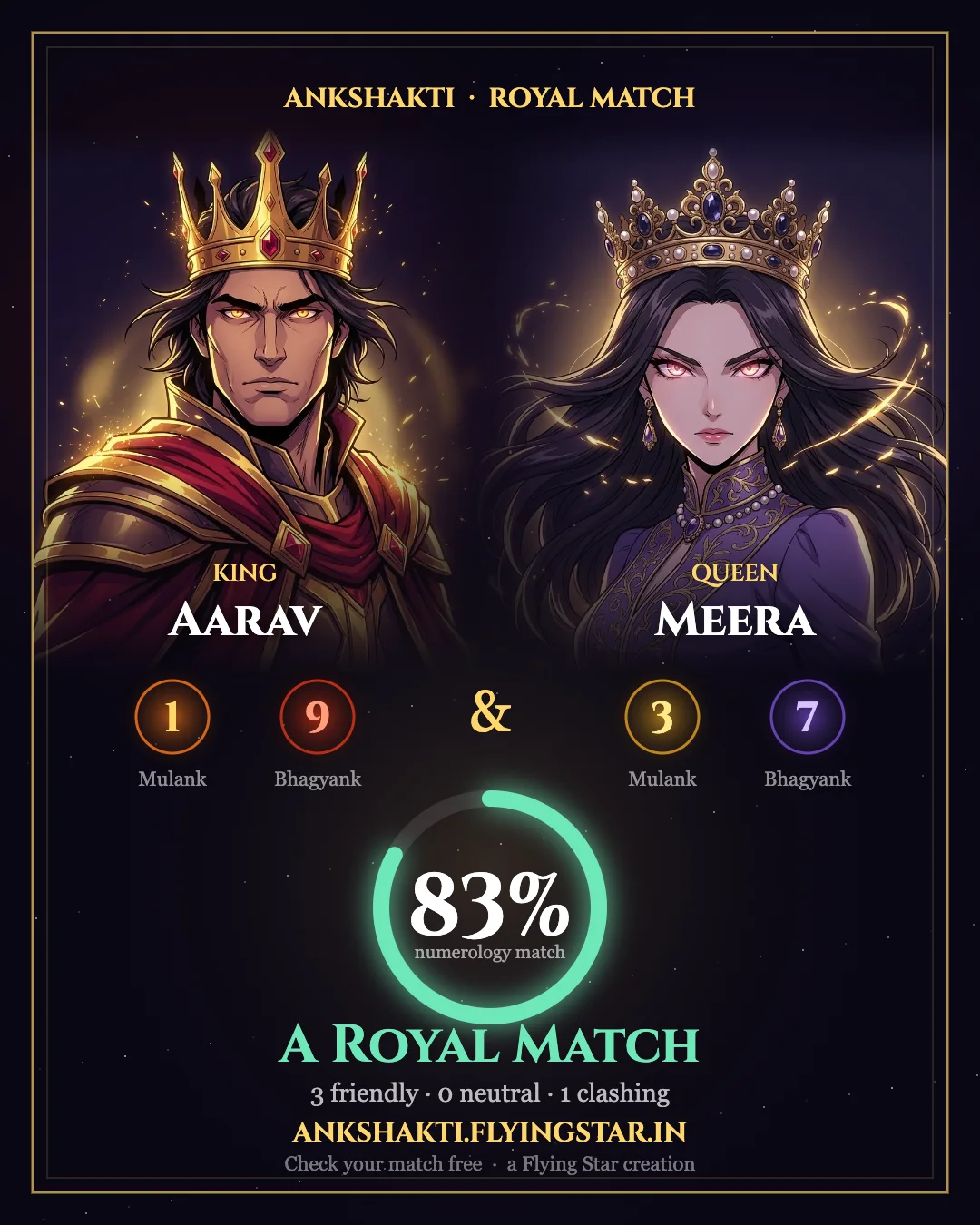
Take two example people. Aarav was born on 01-09-1988, so his mulank is 1 (Sun) and his bhagyank is 9 (Mars). Meera was born on 03-01-1992, so her mulank is 3 (Jupiter) and her bhagyank is 7 (Ketu).
Mulank 1 with mulank 3: Sun and Jupiter are friends, so friendly. Bhagyank 9 with bhagyank 7: Mars and Ketu are friends in the common convention, so friendly. Aarav's mulank 1 with Meera's bhagyank 7: the Sun and Ketu clash. Aarav's bhagyank 9 with Meera's mulank 3: Mars and Jupiter are friends. That is three friendly pairings and one clash: 2 x 2 + 2 x 2 + 0 + 2 = 10 out of 12, which is 83%, an excellent match.
The one clash is still worth reading. A high score does not hide it; it tells you which pairing is the tender spot. The card below shows the same result.
What a low score does and does not mean
A low score means the planets behind the numbers are traditionally unfriendly. It does not describe how two real people treat each other. Habits, values, family and plain effort do not appear in a date of birth.
Practitioners usually read a clash as a topic to be aware of, not a verdict. Two people whose numbers clash can see exactly where friction tends to show up and decide what to do about it. Two people with a perfect score can still struggle. Use the result as a conversation starter and nothing more.
Where schools disagree
Rahu (4) and Ketu (7) are the least settled. The classical planetary friendships cover the Sun to Saturn, and placing Rahu and Ketu follows common Indian numerology practice, which not every teacher accepts. If a result turns on a 4 or a 7, a neutral reading means neutral, not a warning.
Some practitioners also add the name number or the personal year to a couple reading. This match uses birth dates only, which are fixed and need no spelling decisions.
Make the card for your own match
On the compatibility page you enter two dates of birth, add optional names, and the page draws a royal match card with a king and a queen. You can swap who wears which crown, save the card as an image sized for an Instagram post, and copy a caption written from the same numbers.
The dates and names stay in your browser. A share link carries the two dates only, never the names.

Try it on your own name
Common questions
- Which birth numbers matter most for compatibility?
- Most practitioners put bhagyank (the full date) first for long-term questions and mulank (the birth day) for day-to-day behaviour. The AnkShakti score counts mulank with mulank and bhagyank with bhagyank double, and the two crosses once.
- Can a clash between two numbers be fixed?
- A birth number cannot change, because the date of birth is fixed. A clash is a pattern to be aware of, not something to repair, and nothing in a reading like this is guaranteed.
- Is a 100% match the best possible relationship?
- No. A full score only says that every pairing of the four birth numbers is friendly in the traditional table. It says nothing about the two people.
- Does this work for friends, parents or business partners?
- The same pairings apply to any two people, so you can use it for friends, family or partners in a business. The wording on the card is playful and written for couples.
- Are my dates of birth stored or sent anywhere?
- No. The result is worked out in your browser. If you save people to switch between them, they are kept only in your browser storage. A share link carries the two dates but not the names, and you control whether to send it.